What Should You Look for in a High-Quality Industrial Hose?
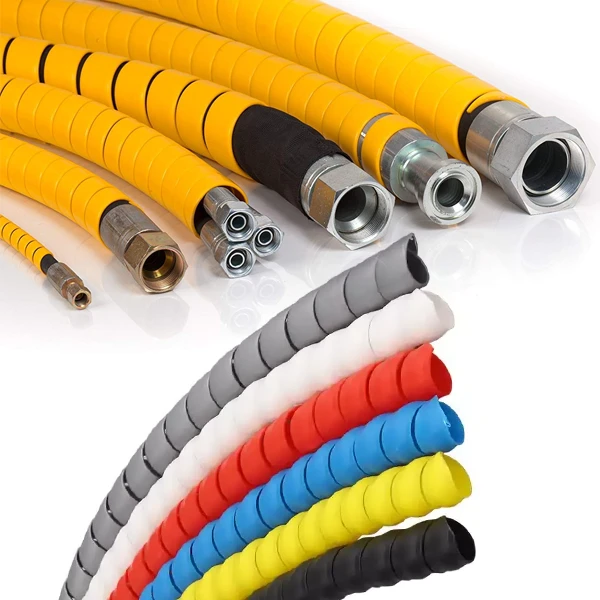
A high-quality industrial hose should match the fluid, pressure, temperature, movement, environment, and coupling system rather than simply carry a high pressure rating. Check the inner-tube compound, reinforcement, cover, working pressure, burst ratio, vacuum rating, minimum bend radius, chemical compatibility, conductivity, and test standard. ISO 7751:2016 addresses proof- and burst-pressure ratios for rubber and plastics hoses, while ISO 1402 covers hydrostatic pressure testing. A hose rated at 20 bar is unsuitable if pressure spikes exceed 20 bar or heat reduces its allowable rating. The complete hose assembly, including fittings, should be rated for the real service conditions, not only normal operating pressure.
A hose should first be judged from the inside outward. The tube touches the transferred material, so its compound has to tolerate the fluid at the actual concentration and temperature. NBR is widely used where petroleum oils are present; EPDM is commonly selected for hot water, steam, weather, and many polar chemicals; PTFE offers broad chemical resistance; polyurethane is frequently chosen where abrasion matters. None of these materials is universally compatible. A chemical chart showing acceptable service at 20°C cannot automatically support the same fluid at 80°C, because temperature can change swelling, permeability, hardness, and bond strength.
That material choice then has to work with the reinforcement. Textile braid can provide flexibility in lower- or medium-pressure service, while steel braid or spiral reinforcement is used where pressure and impulse demand more structural strength. Helical wire is common in suction hose because vacuum tries to collapse the hose inward rather than expand it outward. ISO 7751:2016 remains a useful reference when evaluating relationships among working, proof, and burst pressures, but the applicable product standard and manufacturer data still determine the actual permitted pressure.
Burst pressure is a test limit, not an operating target. A hose that survives a laboratory burst test can still be unsuitable for continuous service near that pressure.
Pressure should therefore be checked as a system value. The rated working pressure of the hose, coupling, adapter, seal, and attachment method all matter; the assembly is limited by its lowest-rated component. Parker's 2024 hose safety guidance also states that surge and transient pressures need to remain below published maximum working pressure, and notes that ordinary mechanical gauges may show average pressure rather than millisecond pressure peaks.
That distinction matters on pumps, reciprocating equipment, valves, and lines that start and stop frequently. A system may normally show 12 bar while short peaks rise much higher. If the hose is selected only from the steady gauge reading, the reinforcement may see repeated stress that was never considered during purchasing. Ask for maximum working pressure, minimum burst pressure, proof-test information, impulse requirements where relevant, and any pressure derating that applies as temperature increases.
Temperature deserves a separate check because hose ratings are usually tied to defined test conditions. Parker notes in its 2024 technical information that thermoplastic hose working-pressure ratings in its catalog are generally based on testing at 68°F (20°C), unless stated otherwise, and that temperature changes can reduce working pressure and coupling retention. A line carrying 90°C oil beside a hot manifold therefore needs more review than a room-temperature water line operating at the same pressure.
Chemical compatibility comes next, and the exact fluid name is not enough. Concentration, temperature, exposure time, contamination, and cleaning chemicals can change the result. A hose used with 10% sodium hydroxide at moderate temperature may behave differently from the same compound exposed to a much stronger solution or repeated hot cleaning. Compatibility should cover the tube, cover where external spills are possible, coupling material, plating, seals, and any adhesive layers used in the hose construction.
For chemical or fuel service, also ask about permeation. Small molecules can migrate through elastomer or thermoplastic walls without obvious cracking. Parker's 2024 safety guidance specifically identifies gases, fuels, and refrigerants as media for which permeation can occur. Ventilation, hose construction, service temperature, and the location of the installation all matter when permeated vapor could accumulate.
The next check is mechanical wear. External abrasion occurs when a hose rubs against floors, frames, reels, steel edges, or moving equipment. Internal abrasion develops when sand, cement, grain, pellets, powders, or slurry repeatedly strike the tube wall. A thicker wall alone does not prove better wear life; compound hardness, resilience, particle size, velocity, bend geometry, and frequency of use all affect material loss.
Where outside contact cannot be removed through routing, a hose protection sleeve can reduce direct rubbing, contain some external damage, and protect the cover from repeated surface contact. It should not be used to compensate for a hose that has already been kinked, cut, softened, cracked, or worn into the reinforcement. Inspection guidance published in 2024 recommends removing damaged hose rather than treating external protection as a structural repair.
| Item to verify | What to ask for | Why it matters |
|---|---|---|
| Working pressure | Rated pressure at operating temperature | Prevents operation above the approved limit |
| Burst data | Test method and minimum burst value | Confirms manufacturing performance, not service pressure |
| Temperature | Fluid and ambient limits | Heat can reduce material and coupling performance |
| Vacuum | Full or partial vacuum rating | Prevents collapse in suction service |
| Bend radius | Minimum permitted radius | Reduces kinking and reinforcement distortion |
| Chemical compatibility | Fluid, concentration, temperature | Prevents swelling, softening, cracking, or permeation |
| Conductivity | Resistance or continuity requirement | Controls static or electrical isolation requirements |
| Couplings | Approved fitting and attachment method | Keeps assembly rating consistent with the hose |
Routing then needs to preserve the properties shown in that table. A hose bent below its minimum bend radius can flatten locally, reduce flow area, distort reinforcement, and place added stress close to the coupling. Twisting creates another problem: braided or spiral reinforcement is designed mainly to react to internal pressure, not continuous torsional loading. The 2024 Parker guidance recommends routing that avoids kinking, twisting, heat sources, and excessive mechanical forces.
Suction service adds another requirement. A discharge hose can have an adequate positive-pressure rating and still collapse when connected to the inlet side of a pump. Reinforcement geometry, wall stiffness, temperature, hose diameter, and vacuum level determine whether the bore stays open. Larger diameters often need stronger anti-collapse construction because the unsupported wall area increases. Request an actual vacuum specification rather than assuming that a visually heavy hose will tolerate suction.
Electrical behavior also needs written data when powders, fuels, paint, gases, or other charge-generating media are transferred. Conductive hose is not defined merely by the presence of a metal helix. The tube compound, reinforcement, fitting contact, bonding method, moisture, age, and assembly construction can affect continuity. Parker's 2024 guidance, for example, requires properly grounded assemblies in several conductive-hose applications and calls for monthly conductivity testing for certain CNG hose assemblies.
Couplings should receive the same level of attention as the hose body. A 25-bar hose connected to a fitting approved for only 16 bar does not create a 25-bar assembly. Clamp style, ferrule length, insert geometry, crimp diameter, hose wall thickness, and reinforcement type all affect retention. Coupling dimensions should come from a validated assembly procedure rather than from visual fit, because over-crimping can damage the tube or reinforcement while under-crimping can reduce holding force.
Manufacturing consistency can be checked through dimensions and documentation. Compare inner diameter, outer diameter, wall thickness, concentricity, length tolerance, layline marking, batch identification, and coupling dimensions across deliveries. A small inner-diameter change can alter velocity and pressure loss, especially in long runs, while excessive OD variation can make crimp settings less repeatable. ISO 1402 and ISO 7751:2016 provide recognized frameworks around pressure testing and pressure relationships, and the applicable hose standard may add dimensions, electrical limits, temperature requirements, or construction rules.
Before approval, request a technical data sheet rather than relying on terms such as “heavy duty” or “industrial grade.” Useful documentation includes maximum working pressure, burst requirement, temperature range, vacuum rating, bend radius, electrical specification, compatible couplings, applicable standards, tube and cover compounds, manufacturing tolerance, and traceability information. A 2021 confirmation kept ISO 7751:2016 current after systematic review, illustrating why standard number and edition year should both appear in technical documentation rather than a vague statement that a hose is “ISO compliant.”
-
Record the exact media, including concentration and cleaning fluids.
-
Record normal pressure plus measured surge pressure.
-
Check both fluid and ambient temperature.
-
Confirm suction or vacuum conditions.
-
Compare minimum bend radius with the installed routing.
-
Verify coupling, ferrule, seal, and hose compatibility.
-
Inspect abrasion points and add external protection where needed.
-
Check conductivity requirements before transferring fuels, powders, or gases.
-
Ask for batch identification and test documentation for repeat orders.
A purchasing comparison should finally use service conditions rather than price per meter. If one hose needs replacement after 6 months while another lasts 18 months in the same installation, the cheaper purchase can cost more after labor, shutdown time, fluid loss, coupling replacement, and disposal are included. Recording installation date, operating hours, inspection findings, pressure history, and failure location gives maintenance teams usable data for the next replacement instead of relying on appearance or brand claims alone.