Sea Salt or Aquatic? Reading Salty Accords Before You Brief a Perfumer
Salty and aquatic are not the same family, and treating them as one is one of the fastest ways to receive a sample that misses the brief. An aquatic accord is built to smell like air and water: ozonic, transparent, often with melon or cucumber facets. A salty accord is built to smell like skin after swimming: mineral, warm, faintly savoury, and much closer to the body. Which one you ask for changes the materials, the structure and the way the finished product reads on a shelf.
Key takeaways
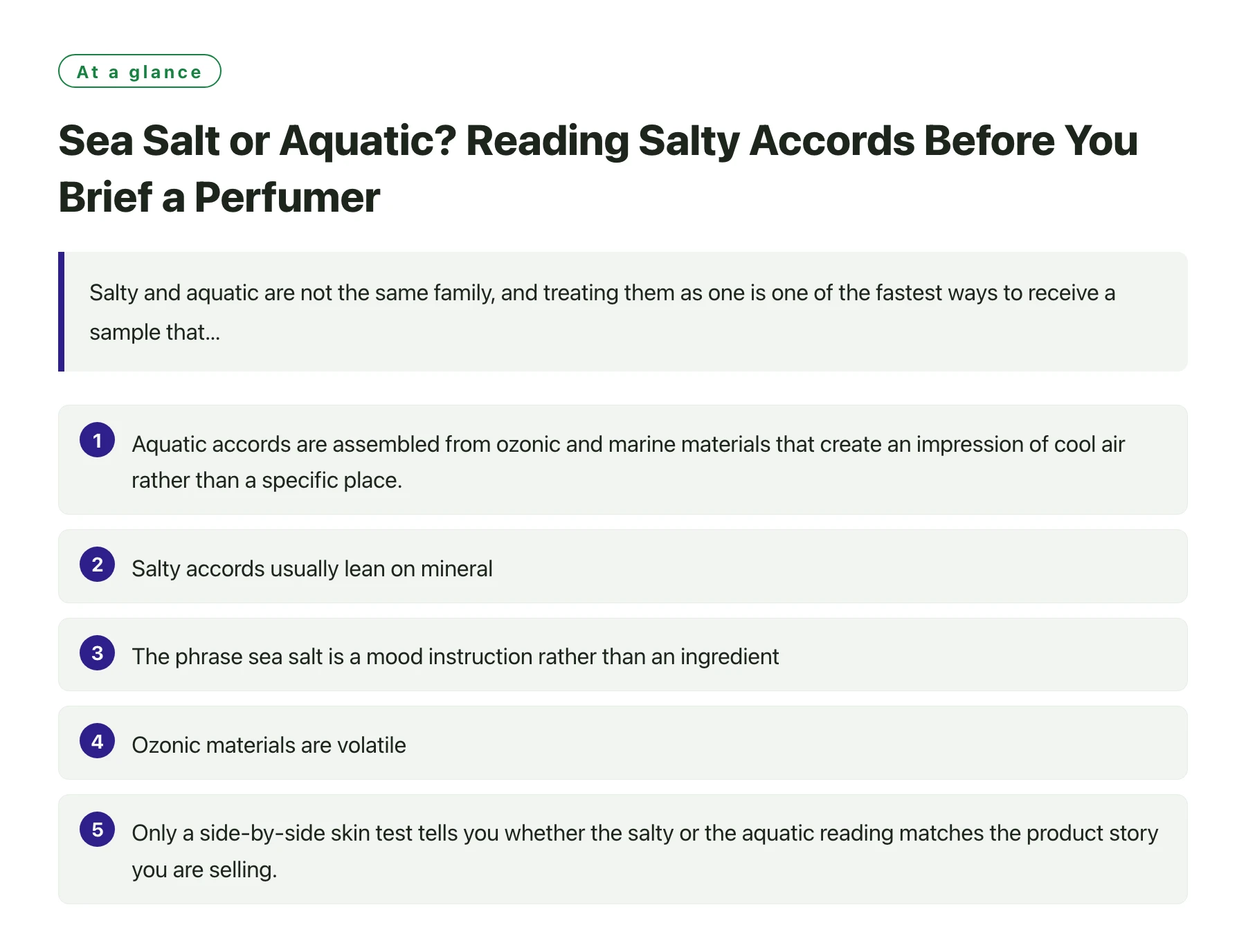
- Aquatic accords are assembled from ozonic and marine materials that create an impression of cool air rather than a specific place.
- Salty accords usually lean on mineral, amber and woody materials that sit closer to the skin and hold longer than a marine top.
- The phrase sea salt is a mood instruction rather than an ingredient, so the perfumer still has to decide which salt effect to build.
- Ozonic materials are volatile, so a salt-forward brief often needs more base support to stay detectable at hour four.
- Only a side-by-side skin test tells you whether the salty or the aquatic reading matches the product story you are selling.
Ask five people what an aquatic fragrance smells like and you will get five answers: a swimming pool, rain on hot pavement, a beach at noon, laundry drying in wind, a slice of watermelon. All of those impressions come from the same small group of materials, arranged differently. The confusion is not the buyer's fault, because the word aquatic names a feeling rather than a recipe.
Salt has the opposite problem. Almost nobody smells salt in a bottle and thinks of water. Salt in a formula usually reads as warm skin, dry air, mineral stone or a faint savoury edge, and it behaves very differently from the ozonic notes that make a marine accord sparkle. Briefing one direction while expecting the other is a common and expensive misunderstanding.
This article separates the two families, shows what each one is normally built from, and gives a briefing sequence that keeps the sample rounds short.
Where the aquatic family comes from and what it is made of
The modern aquatic family is usually traced to a small number of late twentieth century launches that relied on synthetic materials with an ozonic, almost metallic freshness. Those materials do not smell like water on their own. They create the impression of cool air and open space, and the mind supplies the sea. Databases that catalogue aroma materials by odour description are a useful way to see how wide that group actually is [1].
Two sub-groups do most of the work. Ozonic materials supply the cool, airy lift that hits in the first minute. Marine and melon-like materials supply the watery, slightly sweet body underneath it. The second group is the reason so many aquatics share a recognisable melon-and-seaweed signature, and it is also the reason they can turn sharp on some skin.
Why aquatics feel light even when the oil load is high
Aquatic formulas are structurally top-heavy. A large share of the effect lives in materials that evaporate quickly, so the accord is loud for twenty minutes and then thins out. Raising the concentration does not fix that, because the materials doing the work are still the fast ones.
The practical consequence is that an aquatic brief and a long wear target pull against each other. If the product needs to still be recognisable after four hours, the formula needs base materials that carry the marine idea forward rather than a higher percentage of the same volatile top.
The brief problem with the word ocean
Ocean is a mood, not a specification. Two briefs that both say ocean can mean a cold northern shoreline, a warm gulf at midday, or the inside of a diving mask. Each of those needs a different balance of cold air, salt and warmth.
A more useful first sentence names temperature, light and distance: is the scent cold or warm, bright or shadowed, does it sit on the skin or fill a room. Those three choices reduce the sample round far more than a list of note names does.
What a genuinely salty direction adds
A salty accord borrows from a different shelf. Mineral materials, soft ambers and certain musks create a dry, saline effect that reads as skin rather than sea. It can also be nudged with a trace of aromatic herb or dry wood to give the salt a savoury edge.
Because these materials are heavier and slower than ozonics, a salty direction tends to sit closer to the body and last longer. That is often exactly what a brand wants, and it is also why buyers who asked for a salty concept sometimes describe the result as quiet on first smelling.
Five salt directions and what each one actually does
| Salt direction | Material family it draws on | How it reads on skin | Where it fits |
|---|---|---|---|
| Dry mineral salt | Mineral and amber-like materials with a woody backbone | Warm, close to the skin, slightly dusty | Unisex skin scents and scented body products |
| Sea spray salt | Ozonic and marine materials over a mineral base | Cool, airy, faintly saline in the opening | Summer launches and fresh line extensions |
| Sun-warmed skin salt | Soft musk and light amber with a saline accent | Close, persistent, more skin than sea | After-sun and holiday concepts |
| Savoury salt | Aromatic herbs and dry woody materials | Mineral and faintly edible, polarising | Niche concepts that carry a strong story |
| Salt as texture only | A trace of mineral material under a sweet or floral heart | Hard to name, but the formula feels less flat | Fine fragrance where salt is a modifier, not a theme |
Notice that only one row in this table is a true sea-spray direction. Most of what buyers describe as salty in real projects is mineral, musky or savoury instead, which is why the first clarifying question in a salt brief is usually which of these five the brand actually means.
A briefing sequence that avoids the salt-versus-sea mix-up
- Describe the moment, not the noteWrite two sentences about where and when the product is worn. That context usually points to one of the five directions above without any note names.
- Decide where the salt sits in the structureSalt can be the opening impression, a mid-formula texture, or a dry-down effect. Each option changes which material family the perfumer reaches for.
- Ask for two directions, not oneRequesting an aquatic and a mineral version in the same round gives you a real comparison and costs far less time than a second round later.
- Set a wear target in hoursState when the scent should still be detectable. Without a number, a light aquatic will always look correct on a blotter and disappointing on skin.
- Ask about restricted materials earlyRestrictions apply to the finished formula, and the IFRA standards are the reference most suppliers work from, so headroom should be checked before the concept is locked [2].
- Test on skin, not only on paperPaper shows the opening. Run both candidates on several people and check them at the two-hour and six-hour marks before choosing.
The recurring mistake in this category is approving a salt concept from a blotter in a meeting room. Paper exaggerates the bright, ozonic part of the formula and mutes the mineral and musk materials that only wake up on warm skin, so the sample that felt perfect at the meeting is often the one that feels thin on a customer three hours later. Hold the decision until the strips have been compared against skin samples from at least three people, and judge the dry-down before you judge the opening. It costs one extra week and it prevents a reformulation that costs several.
Choosing between them when the product is already designed
Once the format, price point and channel are fixed, the choice between a salty and an aquatic reading is narrower than it first looks. A high-alcohol spray, a body mist, a solid and a roll-on all deliver the same juice differently, and the louder materials in an aquatic direction are the ones most affected by that difference.
It also helps to know that most manufacturers can work in both directions. Xuelei, a fragrance and home scent manufacturer based in Guangzhou, develops marine and mineral accords for fine fragrance, home fragrance and body care lines, and the same brief often comes back in two readings before one is chosen.
Match the accord to the delivery format
A spray flashes the top notes and moves fast, which suits a sea-spray direction. A roll-on delivers a concentrated dot that warms slowly, which flatters mineral and musky salt far more. A body mist applies a thin film over a large area, so a heavy salty base can disappear into the carrier.
If the same scent has to run across several formats, build the formula around the middle of the wear curve and let the format decide how dramatic the opening should be.
Test the dry-down against the concept
Concepts are usually written about a first impression and evaluated on a last impression. A brief that says sea spray but shows a photograph of dry dunes will pull a perfumer in two directions at once, and the sample will look confused for reasons nobody can name.
Show the reference image and the target wear time together. If they disagree, fix the disagreement on paper before the next sample round rather than after the third.
Check the reference material before you brief
Reading a published explanation of the two families takes ten minutes and prevents a whole round of rework, because it makes the vocabulary concrete. For a side-by-side walkthrough of the same topic, see what separates sea salt from aquatic scents.
Bring that vocabulary to the brief and the conversation stops being about adjectives. You will be asking about volatility, base support and saline texture, which are the things a perfumer can actually act on.
Sources
- The Good Scents Company —— A reference database of aroma materials with odour descriptions, CAS numbers and typical usage information.
- IFRA Standards Library (International Fragrance Association) —— The IFRA Standards Library lists the restrictions the fragrance industry applies to individual fragrance ingredients, based on safety assessments; it is the reference point for compliant fragrance formulation.
Frequently asked questions
Is a salty fragrance the same as an aquatic fragrance?
No. Aquatic describes an ozonic, airy impression built from volatile materials. Salty describes a mineral, warm, skin-close effect built from heavier materials. A formula can include both, but they are separate directions and they behave differently over a wear cycle.
Why does my aquatic sample disappear after an hour?
Most of the effect probably lives in fast-evaporating ozonic materials, so the accord peaks early and thins. The usual fix is more base support carrying the marine idea, not a higher percentage of the same top materials. Check the bulk batch against the approved reference as well.
Can sea salt be listed as an ingredient?
Sea salt in a brief is a description of an effect, not necessarily a raw material. If actual salt or a mineral material is used, it appears in the formula documentation, and the label follows the labelling rules of the market you sell in rather than the marketing name.
Which direction works better in a body mist?
Lighter aquatic directions usually perform better in a mist because the film is thin and the volatile top carries. If you want a salty feel in a mist, ask for a mineral or musky salt with enough base weight to survive dilution, and test it on skin rather than on paper.
How do I decide between two directions during sampling?
Judge them against the written brief, not against personal preference: does each one still read at hour four, does it fit the format and price point, and does it survive on more than one skin type. If both pass, choose the one closer to the story the packaging will tell.